
Synopsis
Garage door spring failure is a leading cause of system breakdowns. Charleston Garage Door LLC explains warning signs, safety risks, and when to schedule reliable garage door repair in Charleston, SC, helping prevent costly damage and restore reliable daily operation.
Your garage door spring is the hardest-working part of your entire system. It carries the full weight of the door on every open and close. When it fails, the door either stops completely or becomes a safety hazard.
Charleston Garage Door LLC is a trusted name in garage door repair and replacement services across Charleston, SC. We have handled spring replacements across the Lowcountry since 2018. We know how quickly a small issue becomes a costly emergency when left alone. We explain what springs do, the warning signs they are failing, why replacement requires trained technicians, and how to get more life from your springs.
- Springs carry your door’s full weight on every cycle
- A broken spring is a safety risk that stresses the whole system
- Coastal conditions accelerate spring wear; early action prevents bigger repairs
What Does a Garage Door Spring Actually Do?
How Springs Support the System
Garage door springs store mechanical energy and release it to lift and lower the door. Without functioning springs, the opener motor cannot move the door on its own. Most residential doors weigh between 100 and 300 pounds, and the springs carry most of that load on every cycle.
Springs work with the cables to keep the door balanced. If one weakens or breaks, the door pulls unevenly or fails to stay up.
Why a Spring Failure Affects Your Whole Door
A broken spring does not just stop the door. It stresses every connected component. The opener motor strains to lift what the spring can no longer support. One failure can lead to cable wear, roller damage, or a burned-out opener motor. Spring problems should always be treated as urgent.
Types of Garage Door Springs in Charleston Homes
Torsion Springs
Torsion springs mount above the door opening and wind under tension to generate the lifting force. Most modern homes rely on torsion springs for their controlled movement, quieter operation, and longer service life.
A standard torsion spring is rated for approximately 10,000 cycles. For a household using the garage twice a day, that is roughly 7 to 9 years of use.
Extension Springs
Extension springs run along the tracks on both sides of the door. More common in older or lightweight door systems, they have a shorter cycle life and are more prone to snapping.
Which Type Holds Up Better Near the Coast?
Torsion springs hold up better near the coast. Their position above the door limits direct exposure to salt air. We use high-quality, heavy-duty springs matched to your door’s weight and size on every replacement.
Garage Door Spring Comparison
| Feature | Torsion Spring | Extension Spring |
| Typical Cycle Life | 10,000–20,000 cycles | 7,000–10,000 cycles |
| Mounting Location | Above the door opening | Along the side tracks |
| Common In | Most modern homes | Older or lightweight systems |
| Salt Air Exposure | Lower (less direct exposure) | Higher (more directly exposed) |
| Failure Risk | Remains on mount when it breaks | Can snap and release suddenly |
Cycle ratings based on manufacturer specifications. Actual lifespan varies by door weight, usage, and environmental conditions. High humidity in coastal South Carolina accelerates garage door spring corrosion, shortening their lifespan for Lowcountry residents.
Signs Your Garage Door Spring Needs Replacement
Catching a spring problem early prevents a full breakdown and protects every other component in the system.
The Door Won’t Lift or Feels Much Heavier Than Normal
If the door feels twice as heavy or won’t lift, a broken spring is the most likely cause. Disconnect the opener and try lifting the door manually. If it drops or takes significant force to raise, the spring has failed. Stop using the door and call for service.
A Loud Bang From the Garage
A broken torsion spring releases its tension all at once, producing a sharp bang. If you hear this and the door stops responding, call for garage door repair in Charleston, SC, right away, and do not operate the door.
The Door Moves Unevenly or Jerks
Uneven spring tension causes the door to tilt, shake, or jerk along the tracks. This adds stress to the cables and rollers.
Visible Gaps or Rust on the Spring
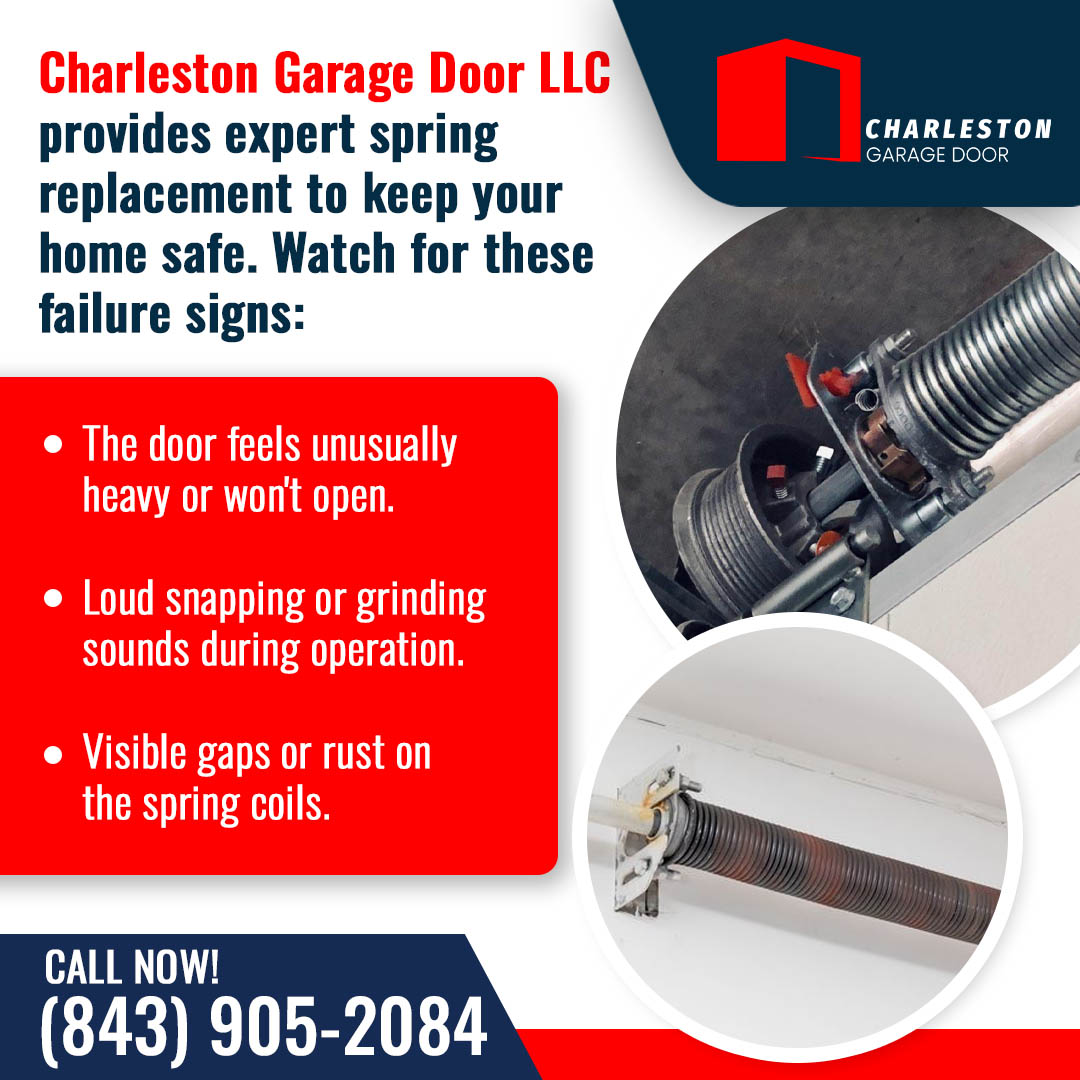
A gap in the coil means the spring has already broken. Reddish discoloration means corrosion is weakening the metal. In the Lowcountry’s salt air and humidity, rust develops faster than in most inland regions.
The Opener Is Struggling or Reversing Mid-Cycle
When the opener works harder than normal, it is compensating for a failing spring. Watch for a door that reverses unexpectedly, stops partway, or makes a strange noise.
Safety note: If you notice more than one of these signs, do not operate the door until a technician has inspected it.
Why Spring Replacement Is Never a Safe DIY Job
The Tension Involved Is Dangerous
Torsion springs are wound under significant force. An unexpected release causes severe injury in a fraction of a second. Spring repairs should never be attempted as a DIY project. The high tension involved requires specialized tools and professional expertise.
Garage door-related injuries treated in U.S. ERs total roughly 20,000 to 30,000 annually in recent years, per CPSC NEISS analyses. Spring failures are among the most serious causes. Federal safety standards effective January 1, 1993, mandated reverse mechanisms on garage door openers. These required new openers to have either an infrared beam (photo-eye), edge sensor, or constant-pressure button to detect obstacles and reverse the door before contact, upgrading from the prior 1982 contact-only reversal.
Sizing Requires Professional Matching
Every spring must be matched to your door’s weight and size. A spring that is too weak or too strong creates an imbalance, accelerating wear on cables, rollers, and the opener motor. Our technicians select the correct spring and confirm proper balance and tension before the job is complete.
What Happens During a Professional Spring Replacement?
When you schedule garage door services with our team, here is what takes place:
Step 1: Inspection and Diagnosis. We examine the door, opener, tracks, cables, and rollers. A detailed assessment ensures all issues are addressed at the same visit.
Step 2: Securing the Door. The door is secured to prevent accidental movement, and the remaining tension is released before the broken spring is removed.
Step 3: Installing the Matched Replacement. The new spring is matched to your door’s weight and size using high-quality, heavy-duty springs suited for Lowcountry conditions.
Step 4: Balance Testing. A correctly installed spring holds the door steady at the halfway point when lifted and released. We adjust the springs until balanced, then test the opener for smooth operation.
How the Coastal Climate Affects Your Springs
Charleston’s combination of salt air, humidity, and seasonal temperature swings causes steel to corrode faster than in most inland areas. A torsion spring rated for 10,000 cycles may reach the end of its service life sooner when exposed to coastal conditions year-round. What looks like surface rust on the coil often reflects more advanced corrosion inside the metal.
Scheduling regular Charleston garage door repair and maintenance visits is one of the most practical steps you can take. A technician can lubricate, inspect for early corrosion, and catch tension issues before they cause a failure.
Repair or Replacement: How We Help You Decide
When Repair May Be Enough
If the coil is intact and within its service life, and the issue is minor tension loss or light surface rust, lubrication and adjustment may restore performance.
When Replacement Is the Right Call
Replace the spring when there is a visible gap in the coil, the spring has snapped, or corrosion has advanced. If your door is more than 10 years old and the original springs have never been changed, proactive replacement is more cost-effective than waiting for a failure.
For two-spring systems, we replace both at the same time. When one fails, the other has completed the same number of cycles under the same conditions. Replacing only the broken one often means returning for the second spring within weeks.
Our customer, Juanita W., left this Google review for us: “Great service! They fixed the spring on the same day in Summerville, super professional and efficient!
Call us at (843) 905-2084 to schedule a same-day assessment with no pressure.
How to Get More Life from Your Garage Door Springs
- Lubricate every 3 to 6 months. Apply a silicone-based lubricant to the spring coils. Avoid WD-40, which attracts dust and debris over time. This slows corrosion and keeps the metal flexible.
- Do not force a struggling door. If the door feels heavier or moves unevenly, stop using it and call for service. Running the system with a weakened spring transfers stress to the cables and rollers.
- Schedule an annual tune-up. A professional maintenance visit includes lubrication, hardware tightening, cable and roller inspection, and a full balance test. It is the most reliable way to catch wear before it becomes a failure.
Frequently Asked Questions
How long do garage door springs last?
Standard torsion springs are rated for 10,000 cycles, roughly 7 to 9 years with typical use. Regular maintenance helps springs reach the full end of their rated service life.
Can I open my garage door with a broken spring?
No. Operating the door with a broken spring stresses the opener, cables, and rollers. The door can drop suddenly and without warning. Leave it in place and call a technician.
How long does spring replacement take?
Spring replacement is typically completed the same day. Our team handles the full process, including inspection, removal, installation, and balance testing, as part of every job.
Do I need to replace both springs at the same time?
Yes. When one spring breaks, the other has the same cycle history. Replacing both prevents a second failure within weeks.
What causes garage door springs to break?
Spring fatigue from repeated cycling is the primary cause. Coastal salt air and humidity accelerate this. Insufficient lubrication also shortens spring life.
Schedule Same-Day Spring Service
Charleston Garage Door LLC has served homeowners across Charleston, West Ashley, North Charleston, James Island, and Summerville since 2018. We work on all residential makes and models using premium-grade parts built for coastal conditions.
What you can count on:
- Same-day service, 24/7 for emergencies
- Transparent pricing before work begins
- Heavy-duty springs matched to your door’s specifications
- Full balance testing on every replacement
- 4.8-star Google rating from local homeowners
Call us at (843) 905-2084 or email us at [email protected] to learn about our team’s garage door services in Charleston, SC. We will help you decide whether garage door repair or full replacement is the right call, with clear answers and no guesswork.